
Whip Worms in Dogs: Signs, Treatment and Prevention

Whip worms (also written whipworms) are thin intestinal parasites that live in the gut of a dog. Many dogs show no signs at all, while others get bloody diarrhea, weight loss and anemia. The eggs can live in soil for years, so a clean yard is not always a safe one. This guide explains the signs, how vets test for them, how treatment works and how to prevent them, using veterinary sources.
By the Paws and Facts Editorial Team. Last checked November 2026. This is general information, not veterinary advice. Where we give our own opinion, we label it “Our advice”. We do not give medicine names or doses.
Key Takeaways
- Whipworms (Trichuris vulpis) are intestinal parasites. Dogs catch them only by swallowing eggs from the environment (CAPC).
- Many infections cause no signs. Others cause diarrhea with mucus or fresh blood, weight loss, dehydration and anemia (CAPC, PetMD).
- Eggs are shed on and off, so a single negative stool test can miss them (CAPC, PetMD).
- Eggs can live in soil for several years, so prompt stool pickup matters (CAPC, PetMD, Today Veterinary Practice).
- Treatment means repeated courses of vet prescribed deworming over several months (PetMD). Never guess a medicine or dose.
- A monthly preventive that covers whipworms plus regular stool tests is the plan the sources agree on.
Quick answer
Diarrhea with mucus or blood, weight loss or a dog that is not thriving is a reason to take a fresh stool sample to your vet. A single negative test does not always rule out whipworms.Whip Worms in Dogs: What They Are and How Dogs Get Them
Whipworms are thread like worms that attach to the wall of the intestine (PetMD). Adults live mainly in the cecum, a pouch where the small and large intestine meet, and occasionally in the end of the small intestine or the colon (CAPC).
| Fact | Detail | Source |
|---|---|---|
| Scientific name | Trichuris vulpis | CAPC, PetMD |
| How dogs get infected | Only by swallowing infective eggs from soil or stool. Not through the mother or other animals carrying them. | CAPC |
| Egg development | Eggs leave in stool and become infective in about 9 to 21 days or longer, depending on soil temperature and moisture | CAPC |
| Egg survival | Highly resistant. Can stay alive for several years | CAPC, PetMD, Today Veterinary Practice |
| Time to adult | Eggs appear in stool about 74 to 90 days after infection | CAPC (PetMD says a cycle of roughly 70 to 94 days) |
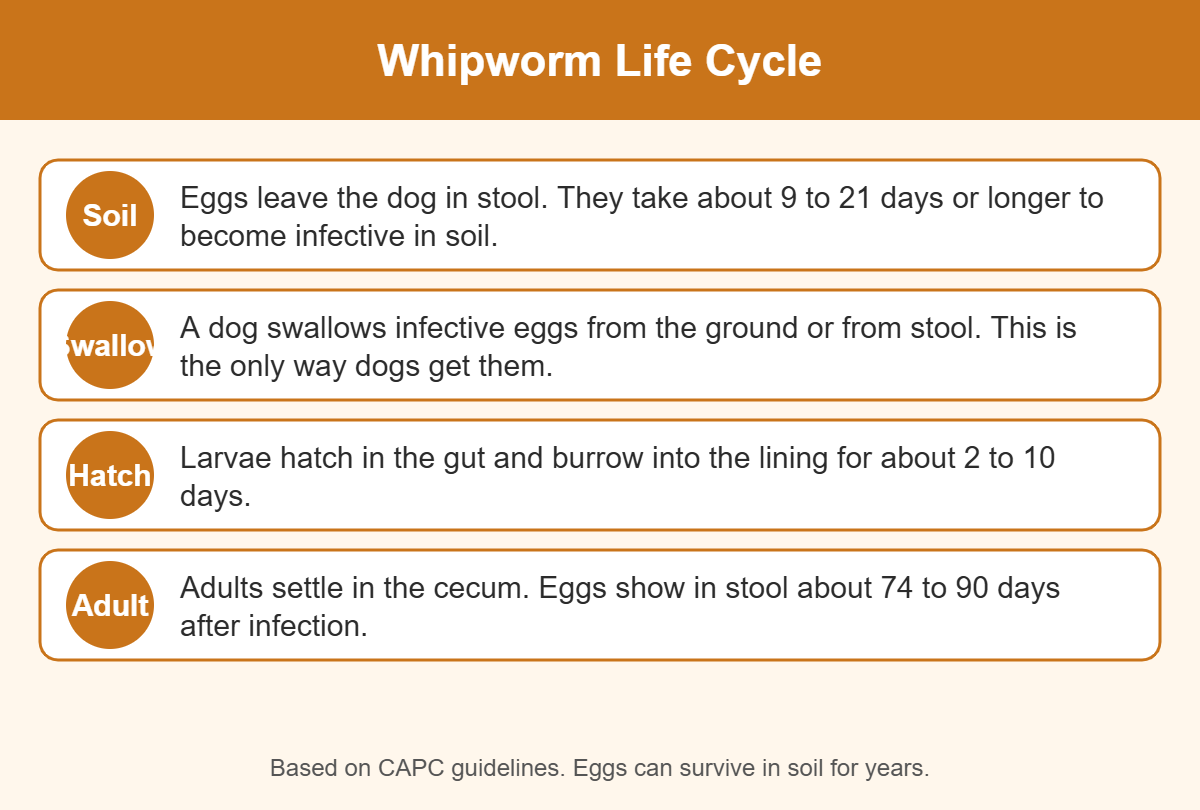
Because the cycle takes so long, a dog can be sick before any eggs show up in a stool test. CAPC notes this is one reason testing can miss an infection early on.
Signs of Whipworms in Dogs
| Sign | What you may see | Source |
|---|---|---|
| No signs | Many dogs look normal | CAPC, PetMD |
| Diarrhea | Often with mucus or fresh blood | CAPC, PetMD |
| Weight loss | Seen in heavier infections | CAPC, PetMD |
| Dehydration and anemia | Can follow heavy infections | CAPC, PetMD |
| Electrolyte imbalance | Can look like another illness called Addison disease | PetMD |
Puppies, senior dogs and dogs with other medical conditions are at greater risk, according to PetMD. Severe infections can be fatal if left untreated (CAPC, PetMD). Many other problems cause diarrhea too, so a vet needs to check the stool rather than guess.
How Vets Test for Whipworms
- Fecal flotation with a spin. Whipworm eggs are dense, so CAPC says a centrifuge is needed, and a sugar solution improves the result. Eggs look football shaped with a cap at each end (PetMD).
- Repeat tests. Eggs are shed on and off, so one negative result can be wrong (CAPC, PetMD).
- Antigen or PCR tests. These can pick up infections that are not shedding eggs yet, but CAPC says they should be combined with a microscope exam.
- Other eggs. Dogs that eat stool can pass look alike eggs from other worms, so a vet reads the result (CAPC).
Our advice: bring a fresh stool sample if your vet asks for one, and write down how long the diarrhea has lasted and whether you have seen blood.
Treatment: What to Expect
PetMD says treatment uses deworming medicine from a vet, given in repeated courses over several months to cover the long life cycle. Follow up testing and ongoing prevention are used to stop reinfection. Our advice: a dog with dehydration or anemia may need more care than deworming alone, so ask your vet.
We do not list drug names or doses. Our advice: never use leftover or store bought dewormers without asking your vet, because the right product depends on your dog weight, age and health, and on which worms are present.
Yard and Home: Why Stool Pickup Matters
Eggs are tough. CAPC says they resist drying, temperature extremes and sunlight, and can remain alive for years. Today Veterinary Practice advises removing stool from the yard promptly and notes that stray dogs that defecate in yards or parks are likely infected and untreated, which raises the risk for pets that spend time outside.
PetMD mentions that sunny, dry conditions help and lists some yard treatments. We cannot confirm how well those work, so ask your vet before using any product on soil where your dog plays.
Prevention Plan
| Source | Puppies | Adult dogs |
|---|---|---|
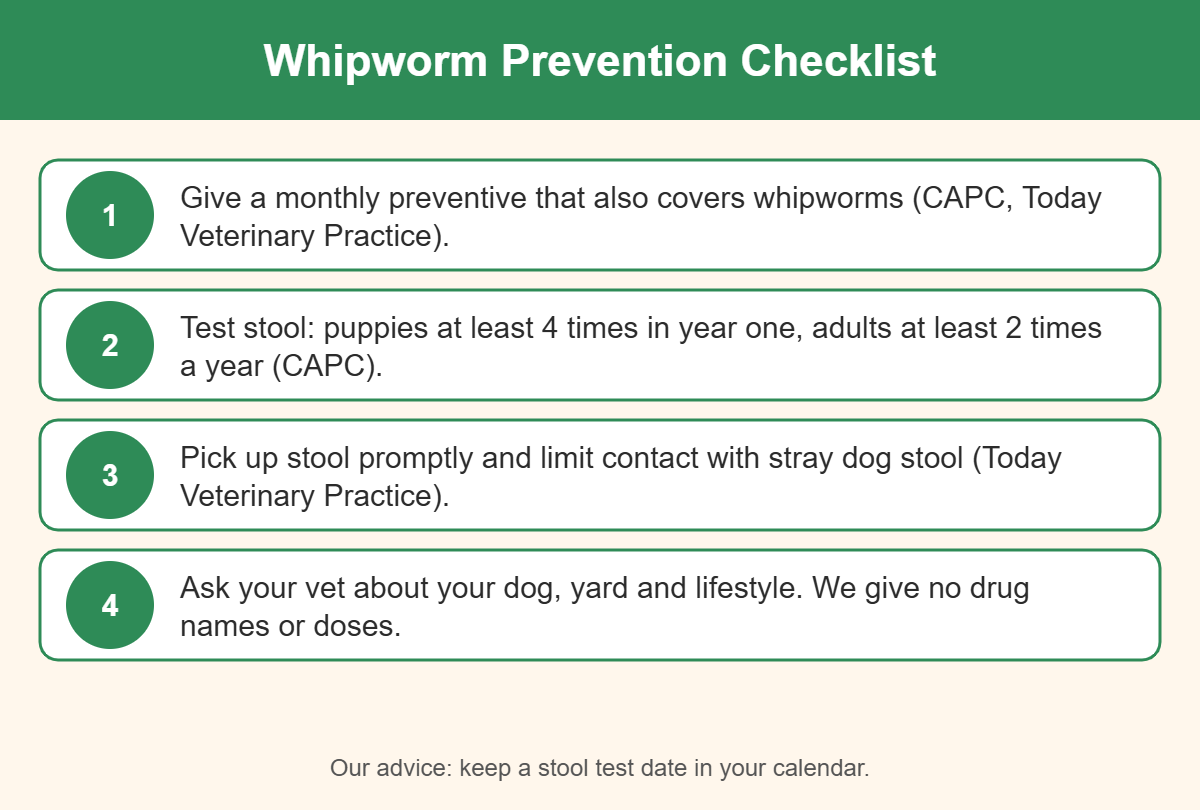
| CAPC | At least 4 stool tests in the first year | At least 2 per year, depending on health and lifestyle |
| Today Veterinary Practice | 2 to 4 tests in the first year | 1 to 2 per year |
| PetMD | At least 4 times a year | 2 times a year |
CAPC says control comes from a monthly broad spectrum preventive that also covers whipworms. If monthly doses cannot be given regularly, CAPC suggests treating adult dogs four times a year, timed with stool tests. Your vet will pick the product and schedule.
SAFE TO DO
- Give a monthly preventive that covers whipworms, as your vet advises
- Pick up stool right away
- Test stool on the schedule your vet gives you
- Keep your dog leashed or in a fenced yard to limit contact with stray dog stool (Today Veterinary Practice)
AVOID
- Treating at home without a stool test or vet advice
- Using leftover or human medicine
- Assuming one negative test rules out whipworms
- Leaving stool in the yard
When to See a Vet Soon
Because the signs overlap with many other stomach problems, a vet visit is the safest next step for any dog with ongoing diarrhea. Our advice: do not wait if you notice any of these.
- Blood or mucus in the stool, which CAPC and PetMD list as common signs
- Weight loss or a dog that is not thriving
- Signs of dehydration or anemia, both named in CAPC as part of severe infections
- Diarrhea in a puppy or a senior dog, since PetMD says these dogs are at greater risk
- A dog with another illness, since PetMD lists these dogs as higher risk too
Questions to Ask Your Vet
- Which stool test do you use, and does it include a spin step for dense eggs?
- Should we repeat the test if the first result is negative?
- Which monthly preventive covers whipworms and suits my dog?
- How many follow up tests do we need after treatment?
- Is my yard or park routine putting my dog at higher risk?
These questions are our own suggestions, not taken from the sources. Writing the answers down helps, because whipworm care runs over several months and the schedule is easy to forget.
Can People Get Whipworms From Dogs?
CAPC says human infections have been reported, but those reports lack enough proof, so it does not consider the dog whipworm a zoonotic parasite at this time. PetMD does not address the question. Our advice: still wash your hands after handling stool and pick it up with a bag, because other dog worms can affect people.

Where Our Sources Differ
| Topic | What we found |
|---|---|
| Cycle length | CAPC 74 to 90 days to egg shedding, PetMD about 70 to 94 days |
| Test frequency in year one | CAPC at least 4, Today Veterinary Practice 2 to 4, PetMD at least 4 per year |
| Human risk | CAPC says not considered zoonotic now, PetMD does not address it |
| Yard treatment | PetMD names some yard treatments, CAPC and Today Veterinary Practice do not, and none give proof of how well they work |
Our advice: where sources differ, follow the schedule your own vet gives you. It is based on your dog, your region and your yard.
Frequently Asked Questions
What are whipworms? Thread like intestinal parasites (Trichuris vulpis) that live in the cecum and attach to the intestinal wall.
How do dogs get them? Only by swallowing infective eggs from soil or stool. CAPC says they do not pass from mother to puppy before birth or through milk.
What are the signs? Many dogs have none. Others have diarrhea with mucus or blood, weight loss, dehydration and anemia.
Can a stool test miss them? Yes. Eggs are shed on and off, and signs can appear before eggs do. CAPC and PetMD both say repeat or extra tests may be needed.
How long do they take to show up in stool? CAPC says eggs appear about 74 to 90 days after infection.
Can they kill a dog? Untreated heavy infections can be fatal through blood loss, diarrhea and nutrient loss, especially in puppies and seniors (CAPC, PetMD).
Can I treat them at home? Our advice: no. Treatment uses vet prescribed medicine in repeated courses, and the right product depends on your dog.
How often should my dog be tested? CAPC says puppies at least 4 times in the first year and adults at least 2 times a year, depending on health and lifestyle.
Final Thoughts
Whip worms are easy to miss and hard to remove from soil, so the winning plan is simple: test stool on schedule, use a vet chosen monthly preventive, and pick up stool every time. If your dog has bloody diarrhea or is losing weight, see your vet instead of waiting.
Photo note
The photos are stock images from Unsplash. The dogs and people shown are illustrations only and do not have this condition.Sources
Flags: where a page has no named author, no reviewer or a commercial publisher, we say so. Where we give opinion, it is labeled Our advice.
- CAPC guideline: Trichuris vulpis (parasite control council guideline, no named authors or reviewers, updated February 2025)
- PetMD: whipworms in dogs (commercial publisher, written by Christina Hawkins DVM, reviewed by Melissa Boldan DVM, updated December 2025)
- Today Veterinary Practice: canine intestinal worm protocols (trade journal article by Dwight Bowman PhD of Cornell and Tom Nelson DVM, 2014 so older, treatment table not read)