Dog Training: Basic Commands and Tips for Beginners
Quick answer
Use short sessions, tasty rewards and one clear word for each command. Start with sit, down, stay, come and leave it, and keep every session happy.
Good dog training does not need force or long hours. It needs short sessions, clear rewards and a calm owner. This guide shows how to teach the five basic commands, what to expect at each age and how to fix common problems.
By the Paws and Facts Editorial Team. Tips are based on the sources listed at the end. Where our advice is our own, we say so.
Key Takeaways
- Reward first: reward based methods have the most benefits and the least harm, says AVSAB.
- Keep it short: 10 minutes or less per session for puppies.
- Be consistent: one word per command and the same words for everyone.
- Start early: training can begin at about 8 weeks, and older dogs can learn too.
- Get help when stuck: a qualified trainer helps with problems that keep coming back.
Dog Training Basics: Why Rewards Work
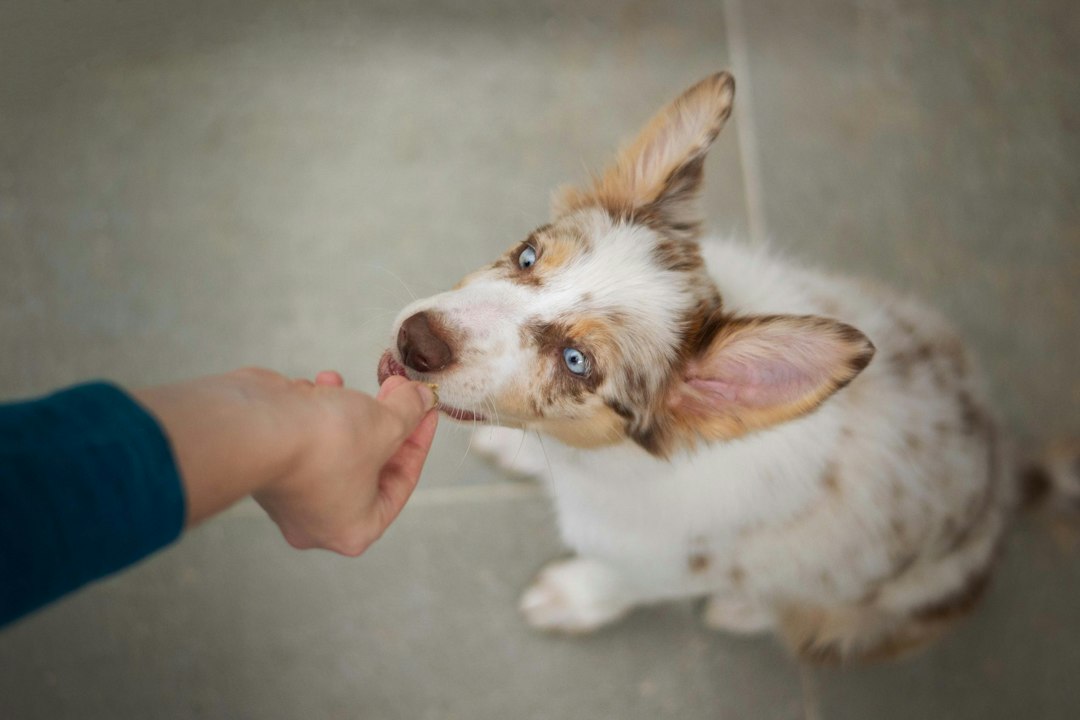
Reward based training means you give your dog something it likes, such as a treat, praise or play, right after it does what you asked. The American Veterinary Society of Animal Behavior (AVSAB) supports this approach for all canine training. Its position statement says reward based methods bring the most benefits with the least harm to a dog, and that research supports them even for hard behavior problems. It also says there is no evidence that aversive methods are needed.
AKC gives similar advice. It recommends force free methods and warns against yelling, punishment or forcing a puppy into scary situations. In plain words, your dog repeats what pays off, so make the right choice pay.
What counts as a reward? Anything your dog loves. Small treats work best at the start. Praise, a toy or a game can follow as your dog learns.
What You Need Before You Start
- Small treats: tiny soft pieces your dog loves. Count them toward daily calories, as Purina advises. If you plan to use human food, check it first, for example in our guides on pineapple and papaya.
- A quiet space: start where nothing else competes for your dog attention.
- A leash and collar or harness: for recall and walking practice.
- A plan for words: pick one word for each command and make sure the whole family uses it.
- A short timer: 10 minutes or less per session keeps puppies keen.
Do I need a clicker? No. A clicker is optional. A clear happy word works too, as long as you give the reward right away.
How to Teach the Five Basic Commands
The steps for sit, down and stay below follow Purina. Come and leave it follow general reward based practice, so treat them as our team guide. Do each step in a calm place, then add distractions slowly.
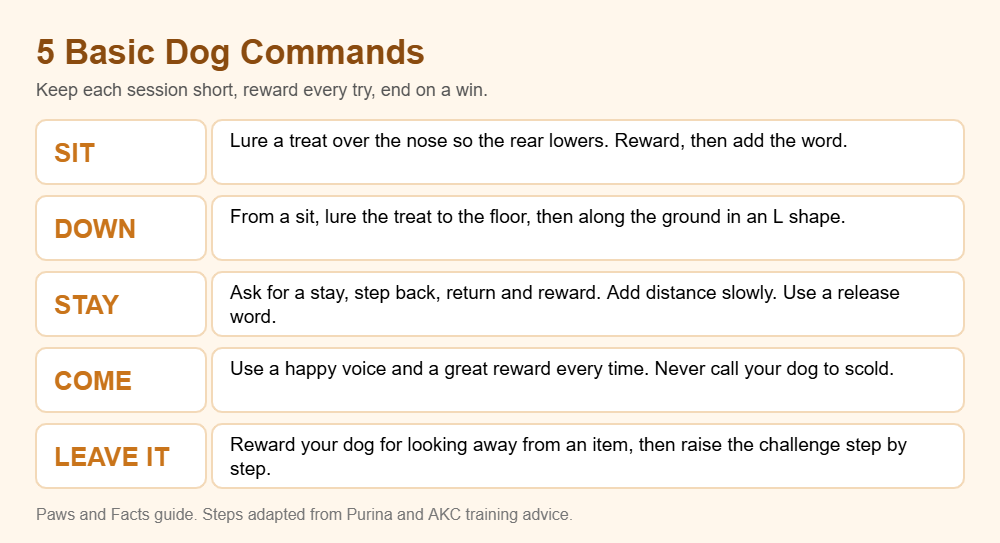
| Command | How to teach it | Common mistake |
|---|---|---|
| Sit | Get eye contact, lure a treat over the head so the rear lowers, reward, fade the lure, then add the word. | Saying the word before your dog understands it |
| Down | From a sit, lure the treat from the nose to the floor in front of the paws, then along the ground in an L shape. Reward and add the word. | Pushing the dog into position |
| Stay | From a known position, give the cue, step back, return and reward. Add distance slowly, then use a release word such as Free. | Adding distance too fast |
| Come | Call in a happy voice and reward well every time. Practice indoors first. | Calling your dog and then scolding |
| Leave it | Reward your dog for looking away from an item, then raise the challenge a little at a time. | Using it only when your dog is already in trouble |
How many times a day? Several short sessions work better than one long one. Purina notes you can hold many sessions in a day as long as each stays short.
Puppy Training Timeline
AKC describes a rough timeline for puppies. The first big window is 8 to 16 weeks, when puppies should meet people, dogs, noises, car rides and vet visits so the world feels safe and interesting. Ask your vet about safe outings before your puppy has finished its vaccines.
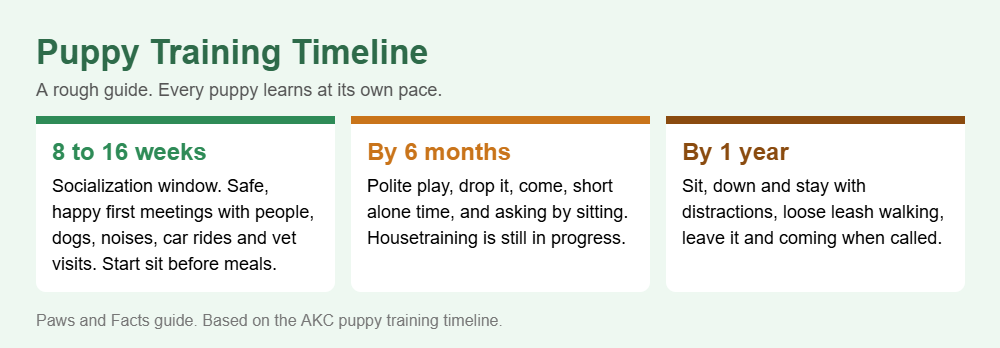
| Age | Focus | Source note |
|---|---|---|
| 8 to 16 weeks | Socialization, handling, sit before meals | AKC says the window closes by 16 weeks |
| By 6 months | Polite play, drop it, come, short time alone, asking by sitting | AKC. Purina also lists potty and crate training and biting |
| By 1 year | Sit, down and stay with distractions, loose leash walking, leave it, coming when called | AKC. Purina lists leave it, heel and stay |
The two sources list slightly different goals, so treat the timeline as a guide. If your puppy is slower or faster, that is normal.
Training an Older Dog
You can still teach an older dog. AKC says the first three to four months with a new dog are key for building trust, and that positive reinforcement helps dogs of any age. Purina adds that older dogs may take longer to adjust. Start with the basics, use small rewards and keep sessions short.
Is it too late? No. A rescue dog may need time to feel safe first. If your dog already answers to a name, you can keep it, and our dog name generator can help if you want a fresh start.
A Simple Daily Plan
This plan is our own suggestion, not a rule. Adjust it to your dog age and energy.
| Time | What to do | Length |
|---|---|---|
| Morning | Sit before breakfast, then one quick down or stay round | 5 to 10 minutes |
| Midday | Practice come inside the home with a reward | 5 minutes |
| Evening | Leash walk practice or leave it, finish with a game | 10 minutes or less |
Skip a session if your dog seems tired or unwell. A short, happy session beats a long, grumpy one.
Common Problems and What to Try
These ideas are general advice from our team. AKC warns against letting barking, jumping or nipping work for attention, so the aim is to reward the calm behavior you want instead.
| Problem | Why it often happens | What to try |
|---|---|---|
| Jumping up | It gets attention | Turn away, then reward four paws on the floor or a sit |
| Pulling on the leash | Pulling gets your dog where it wants to go | Stop when the leash is tight and reward a loose leash |
| Barking for attention | It works | Reward quiet moments and ask for a sit first |
| Nipping | Puppies explore with their mouths | Offer a chew or toy and reward calm play |
| Ignoring come | Come has meant the fun is over | Make it a great word with top rewards and never scold after it |
Does my dog need a stronger correction? AVSAB says there is no evidence that aversive methods are needed. If a problem is serious, get help from a qualified trainer or behavior professional.

Mistakes to Avoid
- Long sessions: puppies lose focus fast.
- Inconsistent words: Down and Off mean different things to a dog.
- Late rewards: reward within a moment of the right action.
- Skipping socialization: AKC says the early window matters.
- Using fear or force: AKC and AVSAB both advise against it.
- Expecting perfect results: practice with small distractions first.
When to Call a Trainer
Call a qualified trainer or behavior professional when a problem keeps coming back, when you feel stuck or when you are unsure how to begin, as Purina suggests. If your dog shows fear, growling or biting, talk to your vet first to rule out pain or illness, then ask for a behavior professional. We cannot judge a dog behavior from an article.
SAFE TO DO
- Keep sessions short and happy
- Reward the moment your dog gets it right
- Use one word for each command
- Let everyone in the home use the same words
- End each session on a success
AVOID
- Yelling or hitting
- Calling your dog to come and then scolding
- Long sessions when your dog is tired
- Changing the word for a command
- Training when you are angry or rushed
Sources
- AKC puppy training timeline: breed club site. The page is sponsored by Purina Pro Plan and has affiliate links, so it has a commercial side. It quotes a certified trainer but names no separate reviewer. Used for the timeline and socialization window.
- Purina basic puppy training: pet food company, so this is a commercial source. Used for session length, sit, down and stay steps and treat advice.
- AVSAB humane training position statement: veterinary behavior society statement, hosted by the Purdue Canine Welfare Center. Used for the case for reward based methods.
- Come, leave it, the daily plan and the common problem tips are general advice from the Paws and Facts team. The two infographics were made by our team from the sources above.
Frequently Asked Questions
How long should a training session be?
Purina advises keeping each session to 10 minutes or less because puppies have short attention spans. You can hold several short sessions in a day.
When should I start teaching my puppy?
AKC says training can begin as early as 8 weeks with positive reinforcement. Purina says to start teaching house rules the day your puppy comes home.
Can an older dog learn new commands?
Yes. AKC and Purina both say older dogs can learn, though they may need more time to adjust. Patience and rewards still work.
Do I always need treats?
Treats help most at the start. Purina suggests moving toward praise over time and counting treats toward your dog daily calories.
Is punishment ever needed?
The American Veterinary Society of Animal Behavior supports reward based methods and says there is no evidence that aversive training is needed. AKC also warns against yelling and forcing a puppy into scary situations.
How many commands should I teach first?
Start with sit, down, stay, come and leave it. Add more only when your dog does these well in a calm place.
How long until my dog is reliable?
It varies. AKC sets a goal of reliable sit, down and stay with distractions by about one year, and Purina lists stay and leave it by one year. Every dog learns at its own pace.
When should I call a trainer?
Call a qualified trainer or behavior professional when problems keep coming back. If your dog shows fear or aggression, talk to your vet first and then a behavior professional.
Final Thoughts
Great dog training comes from small, happy steps. Keep sessions short, reward what you like and use the same words every time. Start with sit, down, stay, come and leave it, and ask a trainer when you are stuck.