Dog Behavior Modification: Methods That Work
Dog behavior modification is a training approach that changes how a dog feels about the things that trigger unwanted behavior, such as other dogs, noises or being left alone. Instead of only teaching commands, it uses rewards, gradual exposure and a calm setup so your dog learns a new emotional response. This guide explains how it differs from basic training, the main techniques, what to avoid, how long it takes and when to bring in a professional.
By the Paws and Facts Editorial Team. Last checked November 2026. This is general information, not veterinary advice. Where we give our own opinion, we label it “Our advice”. We do not give medicine names or doses.
Key Takeaways
- Basic training teaches skills. Behavior modification changes the emotion behind a reaction (Chewy).
- The core tools are counterconditioning, desensitization, shaping and management.
- Reinforcement based methods are the main approach recommended by CCPDT, which opposes methods that cause physical harm or prolonged stress.
- Go slowly. Stop a session before your dog shows stress.
- Start with a vet check, because health problems can drive behavior.
- Ask a certified trainer or veterinary behaviorist if progress stalls.
Quick answer
Rule out health problems with your vet, then expose your dog to its trigger at a level it can handle while pairing it with treats or play. Raise the difficulty only after several calm sessions, and avoid punishment, flooding and harsh tools. Ask a certified professional for help with strong fears or aggression.What Is Behavior Modification in Dogs?
Chewy explains the difference clearly. Basic training teaches a dog new skills, such as sit or come. Behavior modification works on the “big feelings” behind unwanted reactions, so the dog learns to feel differently about a trigger, not just to obey a cue. VCA describes it the same way: the goal is to change the pet’s emotional response so the trigger no longer causes a reaction.
For everyday commands and manners, see our dog training guide for beginners. Come back here when the problem is fear, reactivity or distress.
Dog Behavior Modification Techniques
Several techniques are used together. Chewy and VCA describe these:
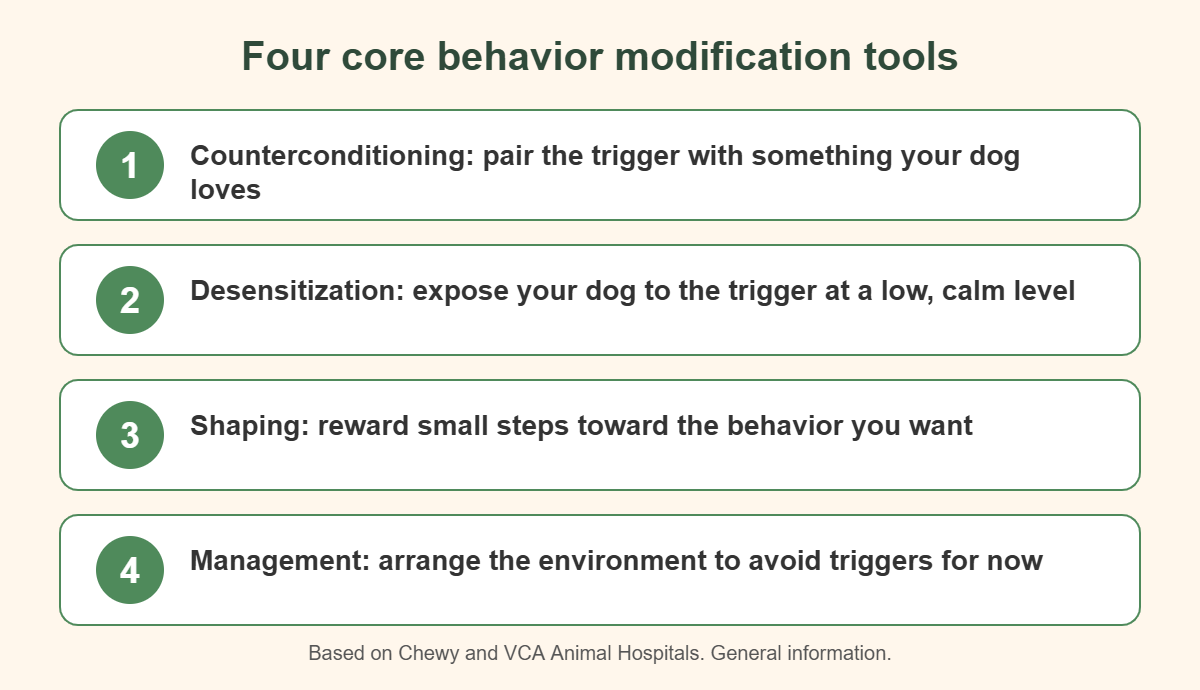
- Counterconditioning. Pairs the trigger with something the dog loves, usually high value treats, so the trigger starts to predict good things.
- Desensitization. Exposes the dog to the trigger at a distance or intensity that does not provoke a reaction, then raises it gradually. VCA says the two are usually combined for strong reactions, and that counterconditioning alone is often not enough.
- Shaping. Rewards small steps toward the behavior you want, such as a brief glance at you instead of at the trigger, and builds from there (Chewy).
- Response substitution. Teaches an alternative behavior that cannot happen at the same time as the unwanted one, such as sitting instead of jumping. VCA says it works best for low to moderate reactions.
- Management. Arranges the environment to avoid triggers. Chewy calls this a temporary measure, not a true fix.
How a session works
- Identify the trigger, a desired behavior such as sitting and a high value reward.
- Lower the intensity by changing distance, volume or speed, or by splitting the trigger into parts.
- Start at a point where your dog is not reacting.
- Pair the trigger with treats.
- If your dog is calm and eating, ask for the behavior and reward it.
- Move closer or raise intensity only slightly, and only after two to three successful sessions.
- End before stress signs appear.
Those steps follow VCA. The source says to move your dog away until it relaxes if it becomes distressed, then either stop or restart at a lower intensity.

Problems Behavior Modification Can Help With
- Leash reactivity, such as barking and lunging at other dogs (Chewy)
- Alarm barking at noises (Chewy)
- Fear of people, objects or handling, such as nail trims (Chewy)
- Distress when left alone (Chewy, VCA)
- Barking at people passing by (Chewy)
Chewy notes that obedience issues, such as jumping on guests, are better handled with basic training. If your dog is anxious in general, ask your vet about the best plan.
A Humane Order of Steps
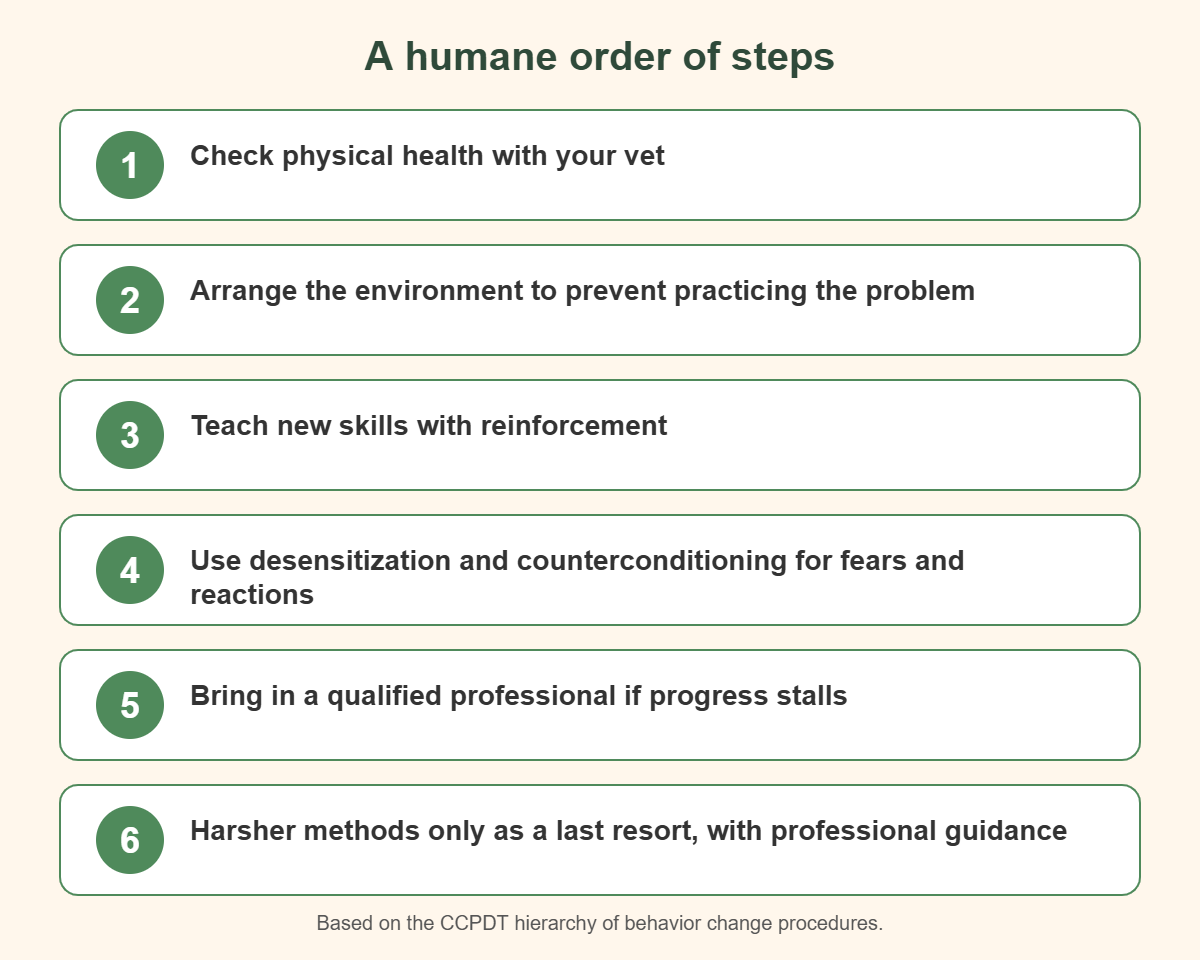
The Certification Council for Professional Dog Trainers (CCPDT) supports reinforcement based training as the main way to change behavior and reduce fear and aggression. It uses a hierarchy that starts with the least intrusive options: physical health, arranging the environment, then positive reinforcement and non aversive conditioning such as desensitization and counterconditioning. Punishment should not be used for convenience, personal preference or as a first step.
How Long Does It Take?
VCA says it can take a few hours, a few weeks or a few months, depending on how strong the emotional response is. Chewy gives no timeline and says long standing patterns will not resolve in a week or two. Our advice: plan for steady practice over weeks, and judge progress by how quickly your dog recovers and how close it can get to a trigger, not by calendar dates.
What to Avoid
- Flooding. Exposing a dog to a full intensity stressor with no escape (Chewy).
- Punishment for the reaction (Chewy, CCPDT).
- Aversive tools such as shock, prong and choke collars. Chewy says they can worsen responses and only suppress behavior.
- Progressing too fast. VCA says a sign is that your dog stops taking treats or settling on cue.
- Continuing while your dog is uncomfortable. VCA says this can cause sensitization, meaning a bigger reaction next time.
- Pushing on without progress. Take a break instead (VCA).

When to Get Professional Help
- Your dog’s fear is strong or it shows aggression.
- Your dog seems more sensitive to the trigger, or progress stalls (VCA).
- You are not sure what the trigger is.
- The behavior appeared suddenly. CCPDT lists physical health as the first thing to check.
Chewy recommends a certified dog trainer or a veterinary behaviorist, and VCA says a veterinary behaviorist may adjust the technique or recommend medication, which can improve results when added to a program. CCPDT says trainers should refer challenging or ineffective cases to other qualified professionals. We do not give medicine names or doses, so ask your vet about options.
Where Our Sources Differ
| Topic | What the sources say | Sources |
|---|---|---|
| Management | Chewy calls management temporary and not a true fix. CCPDT lists environmental management as an early step to prevent practicing the problem. | Chewy, CCPDT |
| Equipment and tools | Chewy says shock, prong and choke collars can worsen responses. CCPDT says equipment is for temporary management and punishment based methods are a last resort when less intrusive methods are documented as insufficient. | Chewy, CCPDT |
| Who to ask first | Chewy recommends a certified trainer or veterinary behaviorist and does not mention general vets. VCA says your veterinarian can help if you are worried about fear or frustration. | Chewy, VCA |
| How long it takes | VCA says hours, weeks or months. Chewy gives no timeline. | VCA, Chewy |
| Doing it yourself | VCA says trying it yourself is fine but expert help is advised if progress is lacking. VCA also warns that strong reactions are tricky without guidance. | VCA |
SAFE TO DO
- See your vet first
- Start below the level where your dog reacts
- Pair triggers with treats or play
- Keep sessions short and positive
- End before stress signs
- Ask a certified professional for strong fears
AVOID
- Punishing a fearful reaction
- Flooding your dog with the trigger
- Shock, prong or choke collars
- Moving to a harder step too soon
- Continuing when your dog refuses treats
- Expecting results in a week or two
Frequently Asked Questions
What is the difference between training and behavior modification?
Chewy says basic training teaches skills such as sit or come, while behavior modification targets the feelings behind unwanted reactions, such as fear or frustration.
Does it work on older dogs?
Chewy says it is never too late to help a reactive dog, but long standing patterns will not resolve in a week or two.
Can I do it myself?
VCA says trying these techniques on your own is fine, but expert help is advised if progress is lacking or the reaction is strong.
Are prong or shock collars part of behavior modification?
Chewy says aversive tools such as shock, prong and choke collars can worsen responses and only suppress behavior. CCPDT says equipment is for temporary management and punishment based methods are a last resort, not a first step.
What is counterconditioning?
It pairs a trigger with something your dog loves, usually high value treats, so the trigger starts to predict good things (Chewy, VCA).
What is flooding and why avoid it?
Chewy describes flooding as exposing a dog to a full intensity stressor with no way to escape. VCA warns that continuing exposure while a dog is uncomfortable can make later reactions bigger.
How often should I practice?
VCA says sessions should happen at least twice a week, ideally daily, and last about 5 to 45 minutes, ending on a positive note.
Who should I hire for help?
Chewy recommends a certified dog trainer or a veterinary behaviorist. Our advice: ask about their methods and certification before you book, and avoid anyone who relies on harsh tools.
Final Thoughts
Dog behavior modification is about changing how your dog feels, one small, rewarded step at a time. Start with your vet, set your dog up to succeed, pair triggers with good things and stop before stress builds. Skip punishment and harsh tools, be patient, and ask a certified trainer or veterinary behaviorist when you need help.
Sources
- CCPDT: Position Statement on Behavior Change Procedures in Dog Training (flag: certifying body, position statement)
- VCA Animal Hospitals: What is behavior modification? Desensitization and counterconditioning (flag: commercial veterinary group, reviewer not confirmed by us)
- Chewy: What is behavior modification? (flag: commercial pet retailer, no reviewer confirmed)