Why Does My Dog Eat Poop? Causes and How to Stop It
Why does my dog eat poop? In most dogs the cause is behavior, such as curiosity, boredom, stress or habit, but sometimes it points to parasites or a digestion problem. The habit is called coprophagia. It is unpleasant to watch, yet it is common, and in most cases it can be managed. This guide explains the main causes, the health risks, what to do at home and when to call your vet, using veterinary sources.
By the Paws and Facts Editorial Team. Last checked November 2026. This is general information, not veterinary advice. Where we give our own opinion, we label it “Our advice”. We do not give medicine names or doses.
Key Takeaways
- Coprophagia means eating feces. It is common in puppies and often fades as they grow up.
- Causes fall into two groups: behavior (curiosity, boredom, stress, attention, habit) and medical (parasites, poor digestion, conditions that raise appetite).
- A dog that suddenly starts eating poop, especially an adult, deserves a vet check.
- Eating another animal’s stool carries the bigger infection risk.
- Cleaning up fast, supervising and teaching “leave it” work better than punishment.
- No commercial deterrent has solid proof behind it, according to the sources we checked.
Quick answer
Most dogs eat poop because of habit, curiosity, boredom, stress or taste. See your vet first to rule out parasites, digestion problems and conditions that raise appetite. Then remove access, supervise outdoor time and train “leave it”. Do not punish your dog.Why Does My Dog Eat Poop? The Main Causes
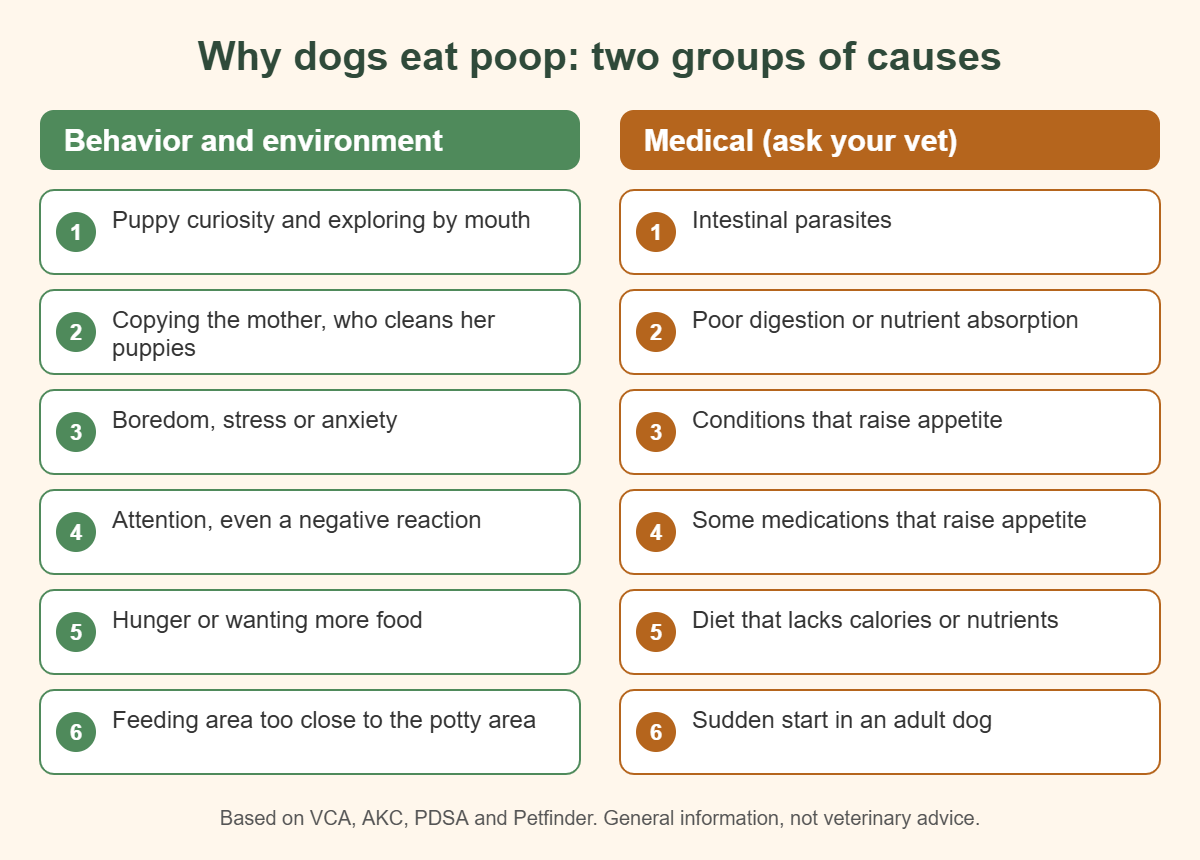
Vets and trainers usually split the causes into two groups. Behavior causes are far more common, but medical causes need to be ruled out first, which is why VCA advises checking for them before treating the problem as purely behavioral.
Behavior and environment causes
- Puppy curiosity. Puppies explore by mouth and may investigate or play with stool (VCA, Petfinder).
- Copying the mother. Mother dogs clean their puppies and eat the waste for about the first three weeks, and pups may imitate this (AKC, Petfinder).
- Boredom, stress or anxiety. PDSA says this is more likely if the habit appears suddenly or only at certain times. Preventive Vet also lists separation anxiety and fear of punishment during potty training.
- Attention. Some dogs learn that eating poop gets a reaction, even a negative one (PDSA, VCA, AKC).
- Hunger. Some dogs have big appetites and look for extra food (PDSA).
- Setup problems. AKC lists long periods alone in small spaces and feeding areas placed near potty areas. Preventive Vet adds crowded conditions.
- Smell and taste. VCA says cat and herbivore stool can be appealing because of its odor, texture or digested plant content.
Medical causes
Any condition that reduces nutrient absorption, upsets the gut or raises appetite can play a part. These are the ones the sources name:
- Intestinal parasites. Roundworms, hookworms and whipworms can cause inflammation and poor absorption (Preventive Vet). VCA says a stool test for parasites is the minimum check.
- Poor digestion. VCA and Petfinder mention digestive enzyme problems and malabsorption.
- Conditions that raise appetite. Diabetes, Cushing’s disease and thyroid disease are listed by VCA, AKC and Preventive Vet.
- Some medications. PDSA says certain medications can increase appetite, so tell your vet if the habit starts after a new prescription.
- Diet gaps. Preventive Vet cites one study linking a B vitamin shortage to the habit, and says shortages are more common in dogs fed raw or homemade diets. Never add supplements without asking your vet.
Is it normal for puppies?
Yes. PDSA says puppies often eat poop out of curiosity and it usually passes with age. AKC says the habit usually fades before about nine months. If an adult dog starts, AKC advises a veterinary checkup.
Is Eating Poop Dangerous for Dogs?
The sources do not fully agree, so here is what each says. AKC says a dog eating its own stool is not dangerous, while stool from other animals may cause problems if it is contaminated with parasites, viruses or toxins. Petfinder lists parasites from wild animal feces, Toxoplasma from free roaming cat feces, parvovirus in unvaccinated dogs and hepatitis from infected dogs’ stool, but notes that for most dogs there is no major risk. Preventive Vet also lists E. coli, Salmonella, Giardia and parvovirus.
PDSA calls the habit unpleasant but rarely harmful, and VCA focuses on the problems behind it, such as poor digestion and nutrient shortages, rather than direct harm from the stool.
Our advice: keep vaccines and parasite prevention current, ask your vet about a regular stool test, and wash your hands after cleaning up.
When to Call the Vet
- The habit starts suddenly, especially in an older dog (AKC, Preventive Vet).
- Your dog also has weight loss, poor coat condition, diarrhea or vomiting (PDSA).
- You notice a bigger appetite or weight changes (Preventive Vet).
- The habit began after a new medication (PDSA, Preventive Vet).
- Your dog eats stool from one particular dog. PDSA says that dog should be checked too.
- Stool looks unusually soft or poorly digested (VCA).
A vet will usually do a physical exam, review the diet and test a stool sample for parasites (VCA). If the cause turns out to be behavior, your vet can refer you to a certified behaviorist (AKC, PDSA).
How to Stop a Dog From Eating Poop
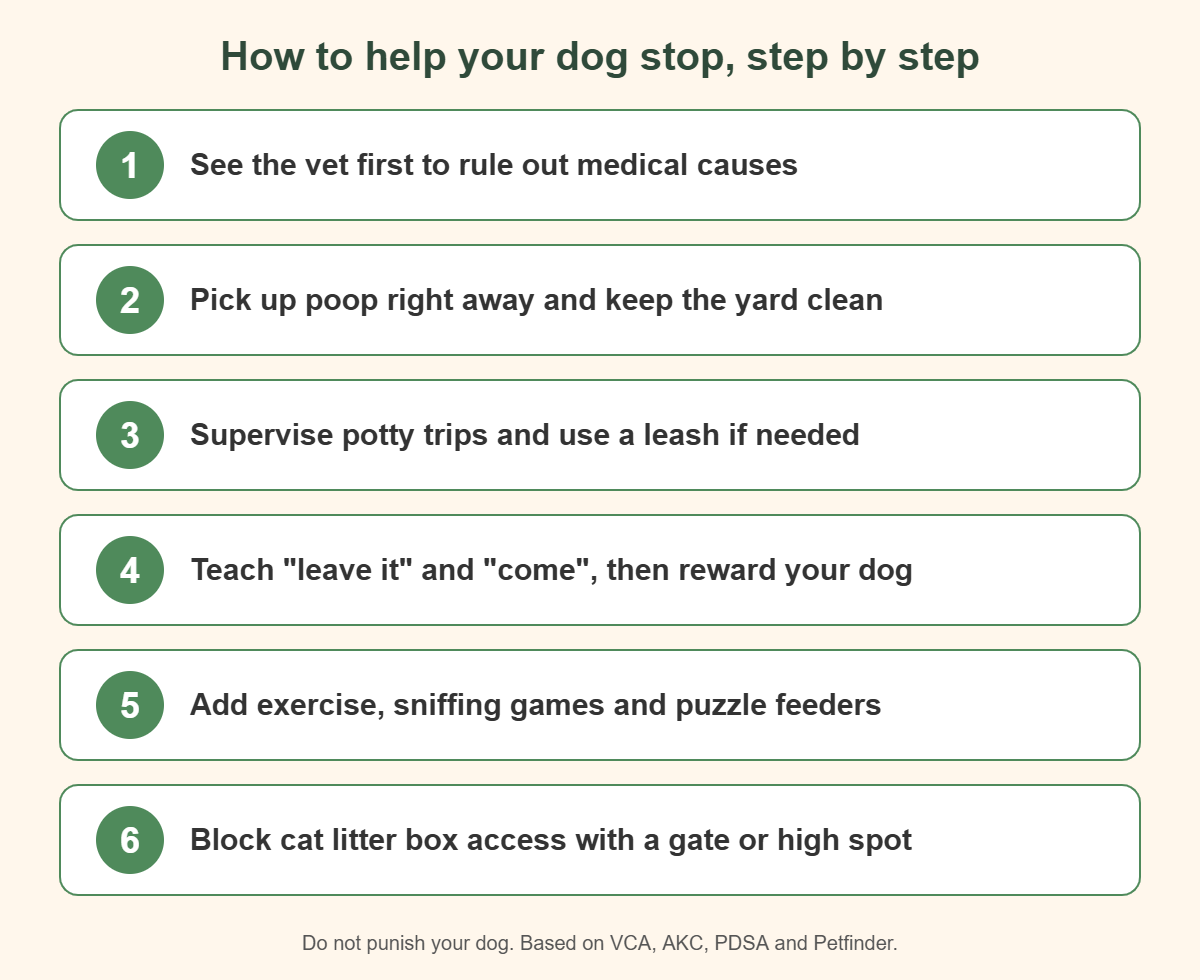
Management comes first. Preventive Vet describes removing access as the most effective approach, and training works best alongside it.
- Get a vet check. Rule out parasites, digestion problems and conditions that raise appetite.
- Remove access. Pick up poop right away and keep the yard clean (all sources).
- Supervise potty trips. Use a leash if needed, and take your dog out, reward it for going, then clean up before leaving it alone (VCA, PDSA).
- Teach “leave it” and “come”. Call your dog to you for a treat when it finishes (AKC, Petfinder, PDSA).
- Add enrichment. Sniffing games, snuffle mats, puzzle feeders and more exercise can reduce boredom (Preventive Vet, Petfinder).
- Review feeding. Preventive Vet and Petfinder say smaller, more frequent meals and a digestible diet may help, so ask your vet.
- Block the litter box. Use a covered box, a gate or a spot your dog cannot reach (PDSA, Petfinder, AKC).
- Stay calm. Do not scold. Reactions can reinforce the habit.
Do Deterrents and Home Remedies Work?
The evidence is thin. Preventive Vet cites a 2018 study that found no commercial product worked for this habit. AKC says digestive enzymes and taste deterrents have anecdotal success only, with no controlled studies. VCA says papaya, yogurt, cottage cheese and breath mints are often suggested but never proven, and that most dogs get used to taste deterrents.
Pineapple is a popular myth. PDSA and Preventive Vet both say there are no studies supporting it. If you are curious about it as a treat, read our guide on whether dogs can have pineapple. Preventive Vet also warns that meat tenderizer has no proof behind it and some products contain unsafe ingredients, and that some breath mints contain ingredients that are very dangerous to dogs.
Our advice: ask your vet before adding any supplement, powder or food to your dog’s diet.
Where Our Sources Differ
| Topic | What the sources say | Sources |
|---|---|---|
| Danger of eating stool | AKC and PDSA say a dog’s own stool is low risk. Petfinder and Preventive Vet list infections from other animals’ stool. VCA focuses on underlying conditions. | AKC, PDSA, Petfinder, Preventive Vet, VCA |
| Muzzles | PDSA says a muzzle does not stop the urge. Preventive Vet lists tight weave basket muzzles as one tool. | PDSA, Preventive Vet |
| Deterrent products | Preventive Vet cites a 2018 study with no success. AKC reports anecdotal success. VCA says most were never proven. | Preventive Vet, AKC, VCA |
| When it fades | AKC says usually before about nine months. PDSA says it usually passes with age. Preventive Vet says it can continue into adulthood. | AKC, PDSA, Preventive Vet |
| How common medical causes are | PDSA calls medical causes very rare. VCA says they should be ruled out before calling it behavior. | PDSA, VCA |
SAFE TO DO
- See your vet first
- Pick up poop right away
- Supervise and leash for potty trips
- Reward “leave it” and “come”
- Keep litter boxes out of reach
- Keep vaccines and parasite prevention current
AVOID
- Punishing or rubbing your dog’s nose in stool
- Relying on a muzzle alone
- Giving supplements or remedies without asking your vet
- Letting your dog eat wildlife or other animals’ droppings
- Leaving poop in the yard
Frequently Asked Questions
Is it normal for puppies to eat poop?
Yes, it is common. Puppies explore the world with their mouths, and mother dogs clean their puppies for the first few weeks, so pups may copy that. AKC says the habit usually fades before about nine months of age. If it continues, ask your vet.
Can eating poop make my dog sick?
It can. Eating another animal’s stool carries the bigger risk because it can carry parasites, viruses or bacteria. Sources disagree on how risky a dog’s own stool is, and most say the larger worry is an underlying health problem.
Why does my adult dog suddenly eat poop?
A sudden start in an adult dog is a reason to see your vet. Sources list parasites, poor digestion, conditions that raise appetite, some medications, stress and boredom as possible causes.
Does punishing my dog stop it?
No. PDSA, Petfinder and VCA all advise against punishment. It can confuse your dog, or teach it to eat stool when you are not looking.
Do pineapple or pumpkin stop a dog from eating poop?
There is no scientific support for pineapple, according to PDSA and Preventive Vet. Preventive Vet says plain pumpkin may add fiber and make stool less appealing, but it presents that as a possibility, not a proven fix. Ask your vet before changing your dog’s diet.
Why does my dog eat cat poop?
VCA says cat and other animals’ stool can be appealing because of its smell, texture or digested content. The fix is to block access: use a covered box, a gate or a high spot your dog cannot reach.
Should my dog wear a muzzle?
Sources disagree. PDSA says a muzzle does not stop the urge and makes cleanup less hygienic. Preventive Vet lists tight weave basket muzzles as a tool for scavenging, alongside training. Talk to your vet or a certified trainer first.
Can I catch something from my dog after it eats poop?
Possibly. Preventive Vet says owners can be exposed to some infections, such as Salmonella and Giardia, through licking and mouthing. Wash your hands after cleaning up and avoid face licks right after the habit.
Final Thoughts
So, why does my dog eat poop? Usually it comes down to curiosity, habit, boredom or stress, but parasites and digestion problems are worth ruling out, especially when the habit starts suddenly. Start with a vet visit, remove access, supervise and reward good choices. Skip punishment and unproven remedies, and be patient, because habits take time to break.
Sources
- VCA Animal Hospitals: Coprophagia (flag: commercial veterinary group, reviewer not confirmed by us)
- American Kennel Club: Why Dogs Eat Poop (flag: commercial, page states it is affiliate supported and sponsored, no reviewer confirmed)
- PDSA: Coprophagia in dogs (UK charity leaflet, may be older)
- Petfinder: 8 Reasons Dogs Eat Poop and How to Stop It (flag: commercial, no reviewer confirmed)
- Preventive Vet: Dog coprophagia guide (flag: commercial, states it gives no individualized medical advice)