Dog Antler Chews: Are They Safe? Vet Concerns
Walk into any pet shop and you will find a basket of dog antler chews sold as a natural, long lasting treat. Owners like the idea of something that does not splinter like a cooked bone and does not run out in ten minutes. The catch is that antlers are very hard, and vets worry about what that hardness does to teeth.
This guide explains what antler chews are, why people buy them, the risks the AKC and a vet writer describe, and how to lower the risk if you still decide to use one. It is based on articles from the American Kennel Club and PetsRadar.
By the Paws and Facts Editorial Team. Last checked November 2026. This is general information, not veterinary advice. Where we give our own opinion, we label it “Our advice”. We do not give medicine names or doses.
Key Takeaways
- Antlers are not guaranteed safe, even for dogs that have chewed them for years.
- The AKC says most veterinarians advise against them.
- The main risks are broken teeth, bleeding gums, blockages and choking.
- Puppies and small dogs face extra risk because of fragile teeth and small jaws.
- If you use an antler, supervise every chew, check it often and never boil it.
- Softer chews and dental treats accepted by the Veterinary Oral Health Council are safer choices.
Quick answer: Antler chews are long lasting but very hard. They can crack teeth and break into pieces that cause blockages. Most vets advise against them, and the safest choice is a softer alternative.
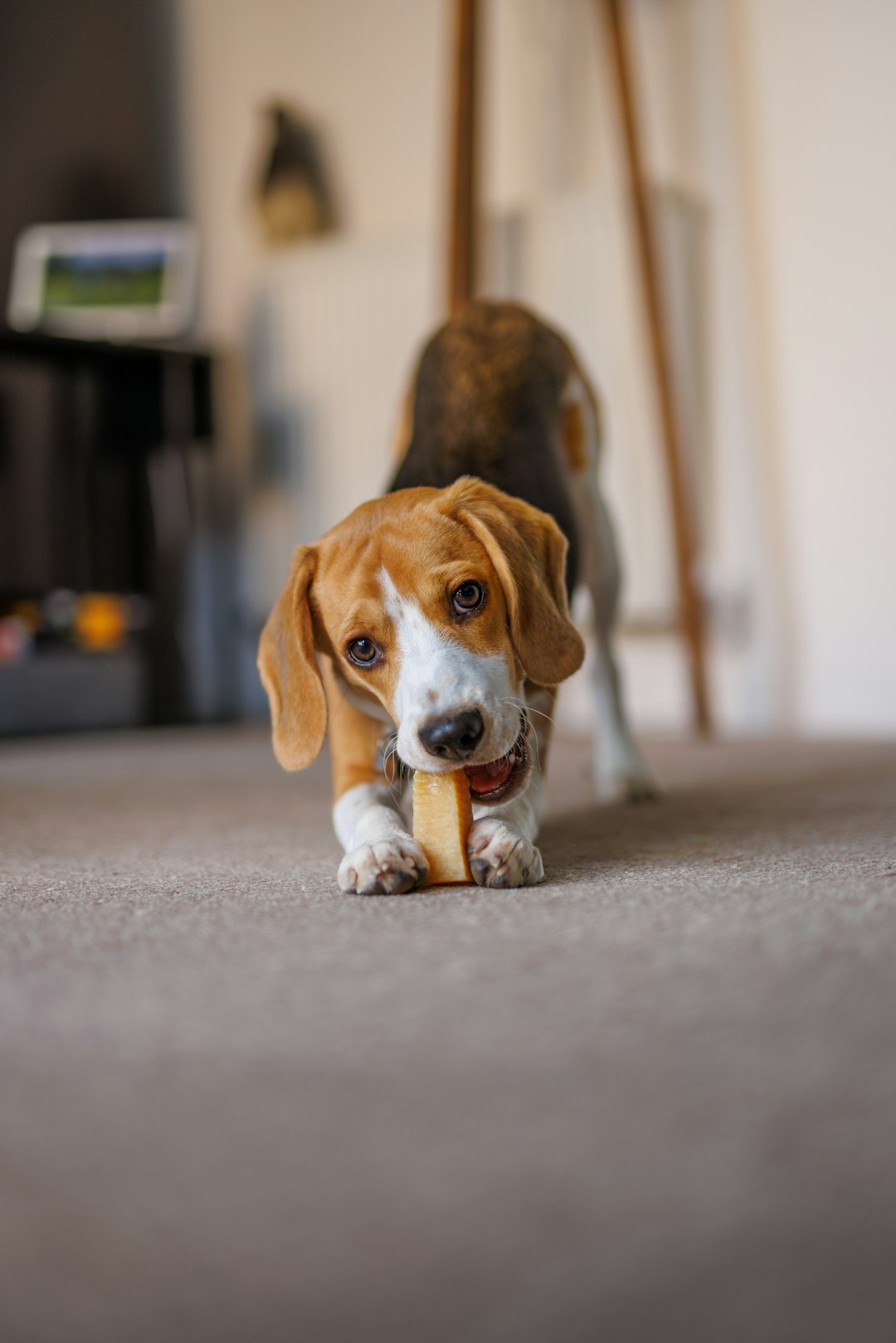
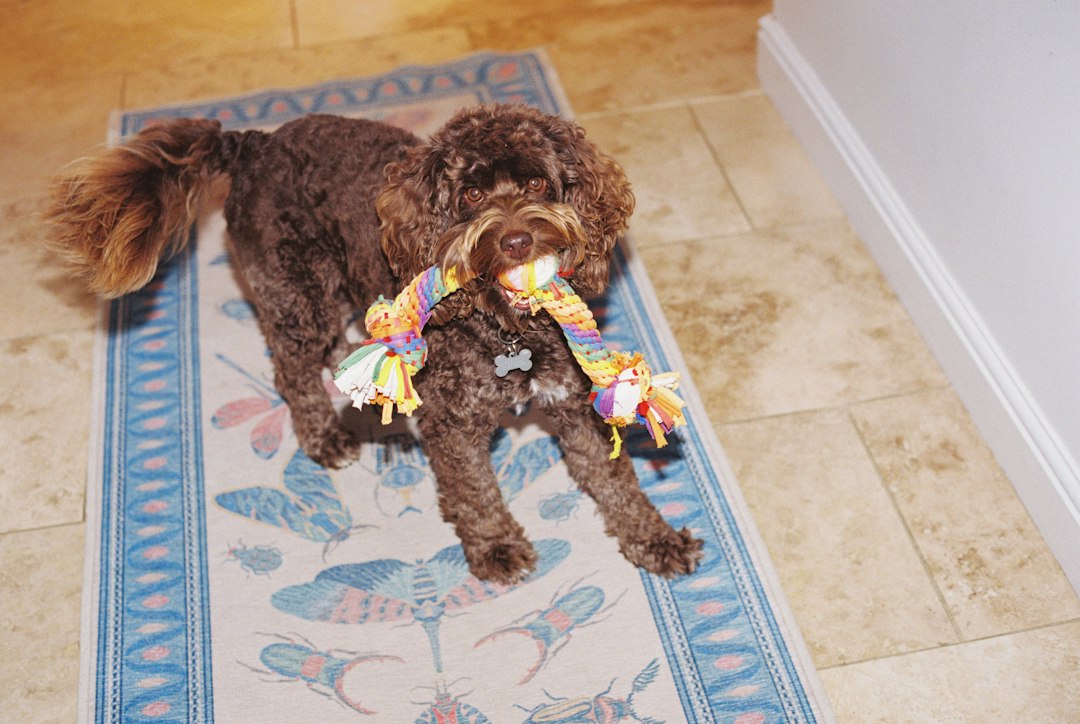
Photo note: the photos on this page are stock images for illustration. The chews shown are not antlers, and the dogs are not our own.
What Are Antler Chews?
Antler chews are pieces of shed antler from deer, elk or moose, cut into sizes for dogs. The AKC describes the main types. Deer antlers are often the hardest and are sold in many sizes. Elk antlers are usually large and sometimes sold split, and their density varies by the part of the antler. Moose antlers are softer than the others and are often sold in slices or shapes. Water buffalo horn is sold as an alternative to antler.
Because the type changes the hardness, two products sold as antler chews can behave very differently in a dog’s mouth. A harder piece is not a better piece. It is simply a bigger risk to teeth.
Why Owners Choose Antlers
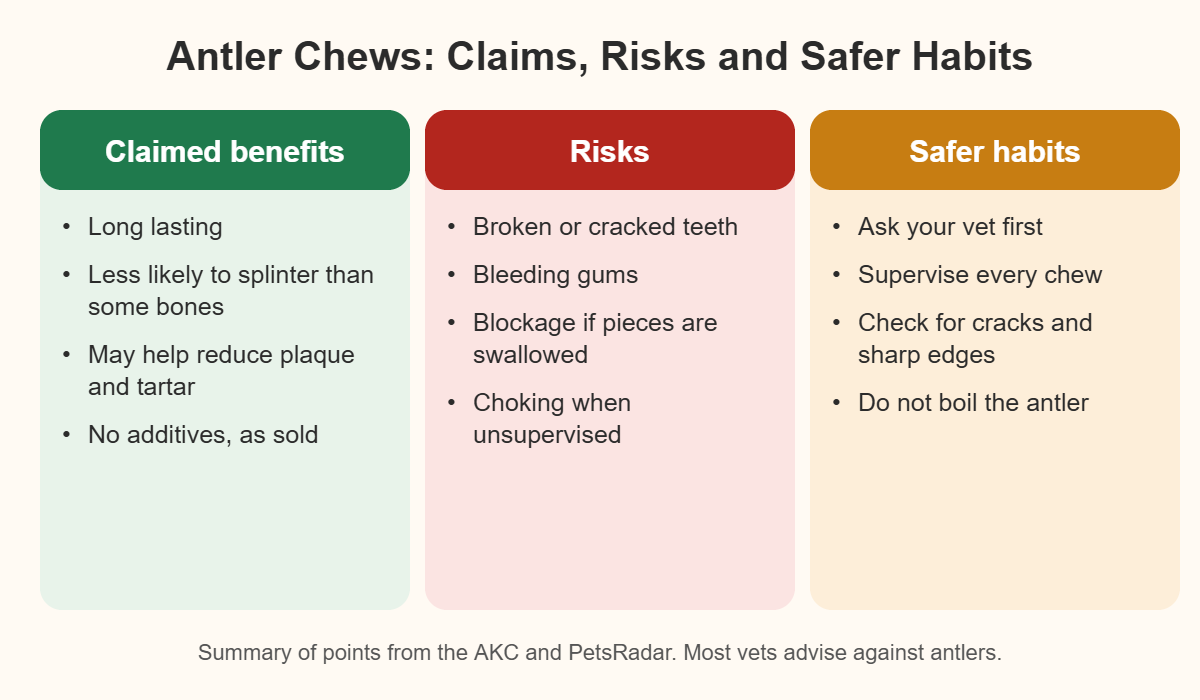
The appeal is easy to understand. The AKC lists the claimed benefits, and PetsRadar adds a few more.
- They seem less likely to splinter than bones or some other toys.
- They last a long time, which can save money for heavy chewers. PetsRadar says often six months to a year.
- They feel natural, with no additives or preservatives.
- As bone, they are low in fat and calories.
- Chewing may reduce plaque and tartar and give anxious or destructive dogs an outlet.
These points are real, but they are claims, not guarantees. Both articles weigh them against the risks below.
Dog Antler Chews: Risks to Know
| Risk | What the sources say |
|---|---|
| Broken teeth | Antlers and other very hard chews are a common cause of broken teeth. They are painful and can lead to abscesses and infection. The AKC says treatment often costs hundreds of dollars. |
| Exposed tooth pulp | PetsRadar says a damaged tooth with exposed pulp may need extraction or a root canal, and broken teeth can lead to jaw infection. |
| Bleeding gums | The AKC says the hard surface can make gums bleed. It is usually minor but uncomfortable. |
| Blockage | Pieces that break or splinter can lodge in the mouth, throat or intestines. This may need emergency surgery. |
| Choking | Dogs chewing without supervision may swallow pieces without anyone noticing. |
| Splintering after boiling | PetsRadar says boiling antlers to soften them makes them more likely to splinter. |
The key point is that the danger is not rare because the dog is careless. It comes from the material. A strong chewer can put a lot of force on a very hard surface, and a tooth is not as hard as an antler.
Do Vets Recommend Antlers?
Mostly no. The AKC says most veterinarians advise against antlers. PetsRadar, written by a vet, says antlers have real benefits but concludes that the safest choice is to avoid them and use an alternative chew. It quotes the line that antler chews will never be entirely safe for any dog.
Where Our Sources Differ
| Topic | AKC | PetsRadar |
|---|---|---|
| Overall view | Not guaranteed safe. Most vets advise against them. | Real benefits, but safest to avoid. |
| Puppies | Not covered in detail on the page we read | Avoid until about one year old |
| Boiling | Not covered on the page we read | Do not boil. It raises splinter risk. |
| Size advice | Pick a size that suits the dog. Chews that do not fit fully in the mouth may lower choking risk. | Small dogs can crack jaws on large antlers. Large dogs can swallow small ones. |
| Reviewer | No reviewer named | Written by a vet |
The two articles agree on the main message. The differences are mostly about detail and who wrote the page.
Puppies and Small Dogs
PetsRadar says puppy teeth are fragile and have short roots, so they are easily damaged. Growing jaws can fracture under the force of chewing. Small breeds face similar problems. Split antlers are not a safe exception.
Its suggestion is that most puppies avoid antlers until they are at least one year old, once adult teeth are in and bones have matured. Our advice is to ask your vet before offering any hard chew to a puppy, because teething already makes chewing urgent and the wrong item can do lasting harm.
Choosing the Right Size
Size cuts both ways. PetsRadar warns that small dogs can crack their jaws on large antlers, while large dogs can swallow small antlers and develop obstructions. The AKC adds that chews that do not fit fully into the mouth may lower the risk of choking and obstruction for aggressive chewers.
The photo above shows a dog with a different kind of chew. It is only an illustration of chewing time.
How to Lower the Risk
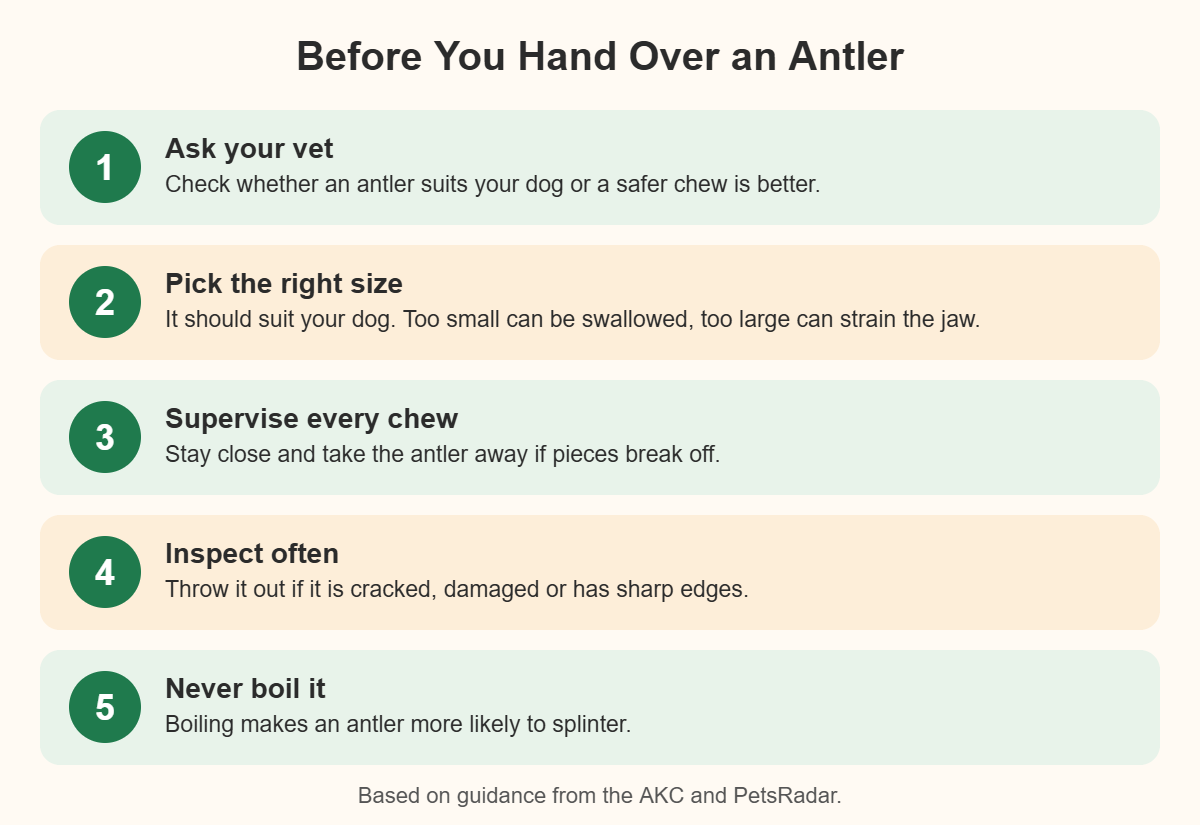
If you decide to use an antler anyway, both sources give practical steps.
SAFE TO DO
- Ask your vet first
- Match the size to your dog
- Supervise every chew
- Check for cracks and sharp edges
- Throw out a weakened antler
AVOID
- Boiling an antler
- Leaving a dog alone with one
- Giving one to a young puppy
- Offering a piece small enough to swallow
- Keeping one that is cracked or splintering
Safer Alternatives
PetsRadar suggests soft, flexible chews, dental treats certified by the Veterinary Oral Health Council, daily toothbrushing and dry kibble for dental care. The AKC also suggests checking the Veterinary Oral Health Council list of accepted chews or asking your veterinarian.
Our advice: rotate a few softer chews and toys so your dog does not get bored, and keep exercise up. A dog that chews because of stress or boredom needs an outlet, not only a harder object. Our dog training guide covers calm ways to teach what is allowed, and our article on whether dogs can eat bones covers another common chew.
When to Call the Vet
Our advice: call your vet if your dog seems to be in pain when chewing, has bleeding gums, drops food, or if you think pieces of a chew were swallowed. Do not wait to see whether it passes. We do not give medicine names or doses, and this page cannot replace a vet visit.
Final Thoughts
Dog antler chews are popular because they last, but their hardness is exactly what worries vets. Broken teeth, blockages and choking are real risks, and puppies and small dogs are especially exposed. If your dog has used antlers without trouble, treat that as luck, not proof. A softer chew, supervision and a chat with your vet are the safer path.
Frequently Asked Questions
Are antlers safe for dogs?
Not guaranteed. The AKC says antlers are not guaranteed safe, even for dogs that have chewed them for years, and that most veterinarians advise against them. PetsRadar says antler chews will never be entirely safe for any dog.
Can antlers break a dog’s teeth?
Yes. The AKC says antlers and other very hard chews are a common cause of broken teeth, which are painful and can lead to abscesses and infection.
Can a dog choke or get a blockage from an antler?
Pieces that break or splinter can lodge in the mouth, throat or intestines. The AKC says this may need emergency surgery, and PetsRadar says some cases are fatal even with treatment.
Are antlers safe for puppies?
PetsRadar says puppy teeth are fragile with short roots and growing jaws can fracture, so most puppies should avoid antlers until at least one year old, when adult teeth are in and bones have matured.
Is a split antler safer?
PetsRadar says split antlers are not a safe exception for puppies. The AKC notes that elk antlers are sometimes sold split and that density varies by part of the antler.
Should I boil an antler to soften it?
No. PetsRadar says boiling makes an antler more likely to splinter, which raises the risk of internal injury.
How long do antlers last?
PetsRadar says they often last six months to a year. The AKC says they last a long time, which can save money for heavy chewers. Long life also means a hard, worn surface, so keep checking it.
What can I give instead of an antler?
PetsRadar suggests soft flexible chews, dental treats accepted by the Veterinary Oral Health Council, daily toothbrushing and dry kibble. The AKC also points owners to the Veterinary Oral Health Council list of accepted chews.
Sources
Sources are listed with notes.
- American Kennel Club: Are antlers for dogs safe? (written by Anna Burke, updated February 2026, no veterinary reviewer named).
- PetsRadar: Antlers for dogs, are they safe and vet recommended? (written by a vet, commercial media site that also mentions products).